Lovely Intangibles


It’s the title I chose for my solo show at Plinth Gallery in Denver. I had jotted down the phrase months ago, but didn’t note the context. I believe I heard it on NPR in reference to something else, but it originated from the delightful 1947 film Miracle on 34th Street:

Look Doris, someday you’re going to find that your way of facing this realistic world just doesn’t work. And when you do, don’t overlook those lovely intangibles. You’ll discover those are the only things that are worthwhile.
~ John Payne as Fred Gailey

The “lovely intangibles” are something I think about when I’m working in my studio and reference about my pots when I teach: the importance of detail (different from decoration), which I define as anything from a slip-trail accent to the ribbed line that delineates a curve. Each of the aesthetic, technical and functional components that make up the whole of a pot —those big and little things that need to be there for me as the maker— may not be definable or even identifiable to the viewer, but if one or more is missing, the whole is no longer the same or as strong. I like the idea that it’s those lovely, imperceptible or even elusive intangibles that are crucial in the completion of a beautiful and useful object. We may not be aware of them when they are there, but somehow we are when they’re not.

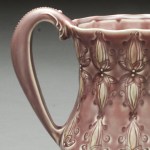
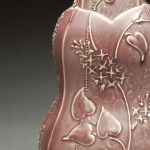
The “important” details pictured, first row: 1. The negative space of a pitcher handle and crisp line that defines the handle itself. 2. The stripes that pop the stamped bunny silhouette, and slip-trailed tail. 3. The top flowing line of a cup handle that leads directly into the lip, and the lines the define the glossy interior and satin exterior. Second row: 4. The red stripes that wrap around and define planes and curves. 5. The cut-aways from a jar foot that create shadows and punctuate the softly squared corners of the body. 6. The thrown, altered and ribbed curves of a large pear jar.

“Veys,” “Veyz,” “Vahz”

Spring means it is finally warming up here in north, central MA. For me, this primarily means things will start to bud and bloom which gets me all excited to sit on our porch and observe my gardenwhich makes me want to make vases.

Last summer (July ’10) during a two-week residency at the Watershed Center for the Arts in Maine, I made a new prototype vase (finished right). As is not uncommon for me, play and design are waylaid by deadlines, so I’ve just gotten around to making a next and improved version now (in-progress left).

Vase forms are a perennial (the pun that had to happen) favorite for me because they can be any shape, size and color, but are equally challenging in the balance between function and beauty (i.e. the potential to elegantly arrange flowers matched with a form that doesn’t overpower the display, but looks attractive and interesting sans posies). “Vase” is such a vague term though because it can be any size, shape and color. I wish there were more specific names for vases intended for certain flowers (like the “tulipiere”) or names that designate a certain size or shape (like the “flower brick”). This Vase In Floral Design page I found gives something close to what I’m craving, giving nice summations on various vase shapes and how they’re used best with tips and notes.

My new, large (15″ h) wire lattice vase is intended, however, to be more sculptural than functional, and is a slight mash-up of form inspiration between a small, cobalt blue glass vase of my Great Grandma’s (similar to the first image below) and a brass antique find that sits in my studio. The wire creates an airy finish to the top of the vase, appearing a bit like a blue-print drawing, a crinoline framework or the unfinished, underlying architecture of the clay part itself. The wire is a way for me to draw in three-dimensions and is a nice contrast material to the clay. (I enjoy working with the wire, but the humbling nature of clay and its shrinkage does not always cooperate with my master plans for elaborate wirework, so we’ll see how it fairs in the firings). I, of course, finished this muscular form off with suggestions of Victorian wallpaper layered over mod candy stripes.

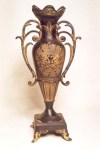
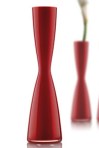
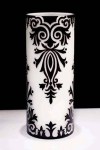
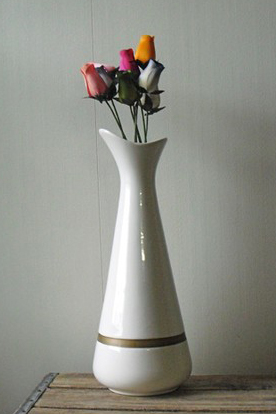
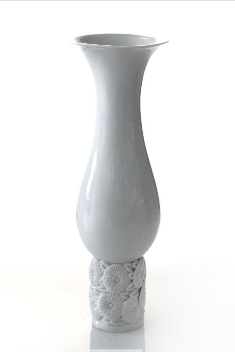
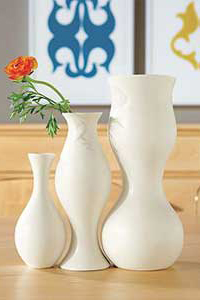
Below are a selection of vases, from antique to contemporary, in a variety of sizes and materials that caught my eye for this post. (You can see the trend that I tend to like pedestal or footed vases.) There are more of my favorites in this post here too. Enjoy!


From top right: Laced-edge glass vase c. 1920; Vintage trumpet milk glass vase; Antique brass vase; and “Eva” solitaire glass vase. Second row: Etched vintage glass vase; Vintage ruby and gold glass vase; Vintage 1950s Hull vase; and antique Louis Majorelle glass and iron vase. Third row: Anika Engelbrecht ceramic, and balloon Swell vases and Petite Friture Ikebana vases. Last row are all KleinReid: Cyril vase, Chateau bud vase, Upright vases by Eva Zeisel for KleinReid, and Peep vase.

*Cake* Cake Stands


As a lover of cake (as influence as well as treat), it makes sense that I would make cake stands. Several years ago, I did make a couple, but lost interest (and apparently didn’t even photograph them).  However!  My new venture into polka dots and stripes in general, and stripe-y plates specifically, has gotten me jazzed to wrap ribbons of striped color down and around to accentuate this fun form.  Above are two recently completed cake stands I photographed from various angles.  Both are about 4″ h x 10″ diameter (able to display an 8 & 9″ cake respectively) with glossy tops and satin-glazed sides.

This summer, I finally got around to making a more substantial cake display form based on my drawings and metal-working influence.  I am humorously referring to it as a “cake throne”.  At some point, I hope to post a pic after the glaze fire, as well as make more. Pictured: Cake Throne detail at leatherhard

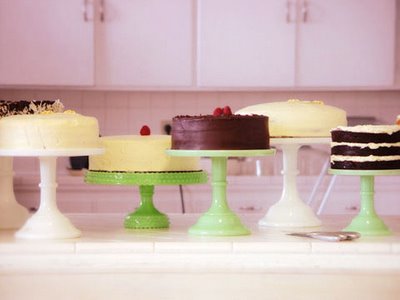
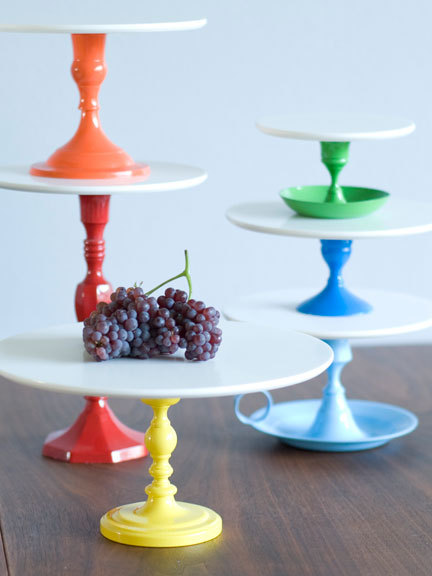
It seemed fun and appropriate to share some other cake stands (with and without cakes, functional and not) in this post, kind of a sideways follow-up of favorites to my Cake as Influence post.  I sometimes use the word “cake” as an adjective to mean “great,” “lucky” or “awesome”.  So, below is a range of very *cake* cake stands (and other peripherally related images) I found in my searches, yielding a range of handmade to manufactured, new to vintage and ceramic to, well, oil. Enjoy!


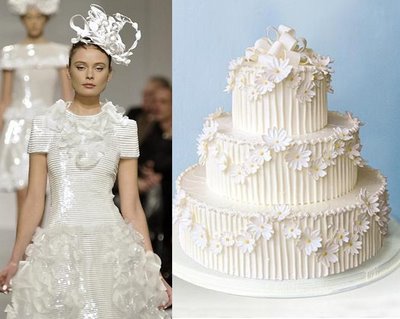
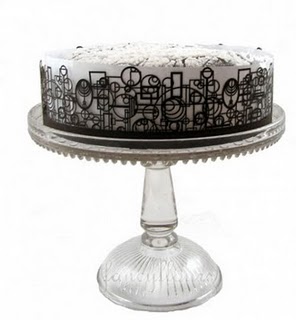
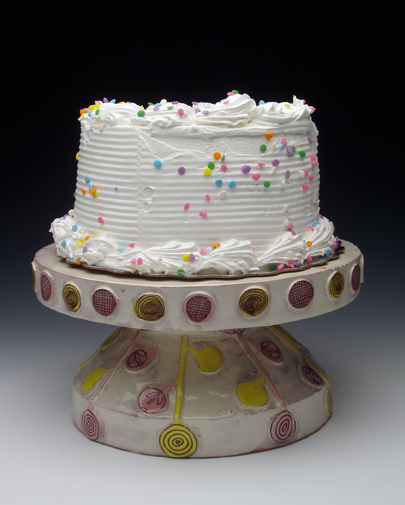
If you hover your cursor over the pics above, you can get most of the info below too. From top left: Vintage glass cake stands with cakes; Esther Coombs’ 3-tier Rose Cake Stand, EstherCoombs on Etsy; and Karl Lagerfeld for Chanel dress paired with wedding cakes, Trend de la Creme blog post; Second row: Blaue Blume cake stand by Tina Tsang; The Husband Catcher Cake, oil painting by Janet Hill; and Art Deco cake stencil wrapper from Fancy Flours; Third row: Silver cake stand;and Maren Kloppmann’s Ledge Platter; Fourth row: Whitney Smith’s Bird Cupcake Stand, WhitneySmith on Etsy; Lemon cake with blue icing and dots, Country Living photo shoot; and Iacolli & Mcalllister cake stands on Big Cartel; Fifth row: Kari Radasch’s cake stand with confetti cake, Redware on Etsy; Lazy Daisy skirts by Made With Love By Hannah (cake stands have skirts, and these are super cute!); and w2products Willow cake stand; Sixth row:  Jeanette Zeis’ Lace cake plate, vesselsandwares on Etsy; 4 Layer Cake, oil painting by Paul Ferney; and antique three-tier cake stand;  Seventh row:  reproduction of 1930s-era glass cake stand; D’lovely cake stand, fergusonpottery on Etsy; and Elle cake stand by Clara French; Last row:  cake stand from The Tea Pot Shoppe; striped cake by The Yummy Cake Company; and Black Lace Cake Stand from the MoMA store.

Signature Style


There are a handful of questions that I am asked at every workshop: “How do you know when to dart?”, “How do you make your feet?”, and “How do you get the stamping to line up?!”, for example. The answers to those are fairly straightforward: practice, carving, and practice.

I’m teasing with the one-word answers, but alongside those simpler, technical how-to questions are toughies like, “How did you find/get/develop your style?” I love deep questions in workshops, the ones that are about being an artist. Those conversations are a big part of why I enjoy teaching. Workshops are a great forum for learning techniques and discussing quandaries like personal style, not for picking up “style tricks.” There is no sincere short answer to the style question during a workshop or in this blog (though “practice” is part of the answer).


A few years ago, while attending NCECA, I attended a lecture* that essentially encouraged the current generation of makers to look not to the former generations’ work for ideas, but rather to their influences. He stated that the prior generation, the WWII-era makers, looked at things (nature, gesture, history, architecture) not other people’s pots.  He expressed wonderment at a potential future in ceramics with artists referencing only the preceding generation.  This observation was profound to me.

To oversimplify with an example, if I like Linda Sikora’s work, rather than imitating her forms and surfaces, I could begin to develop my own voice by researching what has influenced her work. By delving into the handfuls of objects, cultures, and periods that have defined her style, my own work could become unique rather than simply referential. Who I am as a person and maker will affect how I respond to the exact same historic European porcelain pitcher that inspired her. That’s not to say I can’t appreciate, admire, and buy her work, but I am more likely to find my own voice by looking at what is behind her pots rather than just looking at her pots.


So that is one of the anecdotes I tell in a workshop to begin to explain how one might develop a style. I honestly think if an artist sets out with style as the goal rather than as a byproduct of making what he enjoys based on what inspires him, he will fail. (Though I’m sure there are artists who receive recognition this way, I don’t think they are happy, respected artists.)

Style is the amazing culmination of everything an artist has experienced, loves and is, manifested in an object. I touch on the wide range of things that have shaped my own work (and style) throughout this blog, and also discuss them in my Bio and Statement.


The images in this post represent some of the details—based directly on my influences and interests—I feel make my work unique, my style signatures: slip-trailed shapes that look like rolled fondant; ornate stamping; two-part cup handles;  and Kanthal wire as form. Vessels like my Corset series, surfaces like my satin color palette, and even an actual signature, like my name stamp (below) are also part of that design “signature”.  The best compliment I receive about my work is, “I’ve never seen anything like this before.”  What I bring to the pots is something no one else has: my touch, my eye, my mish-mash of interests and my passion. That’s style.

* I’m sorry to say I don’t remember the speaker for that 1998 Dallas/Ft. Worth NCECA slide lecture.  If someone knows, please drop me a note.

Ceramics I Love (Contemporary, Pt. II)

 Gertraud_Mohwald Magdalene_Odundo
 Viola_Frey  Gary_DiPasquale
  
 Alan_Caiger_Smith

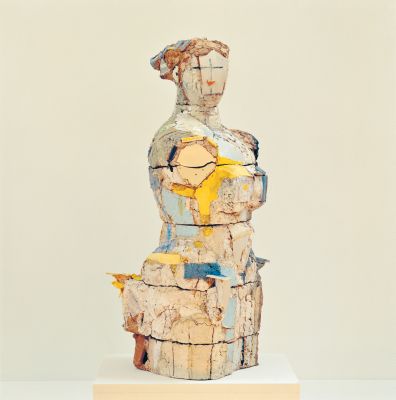
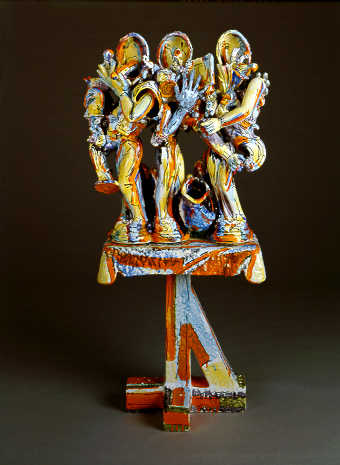
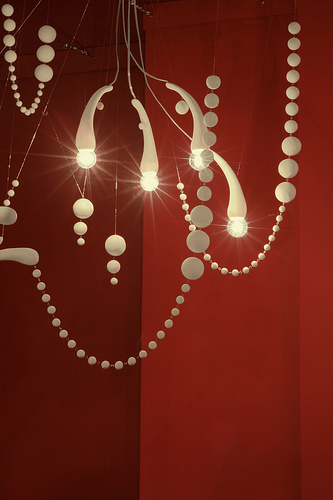
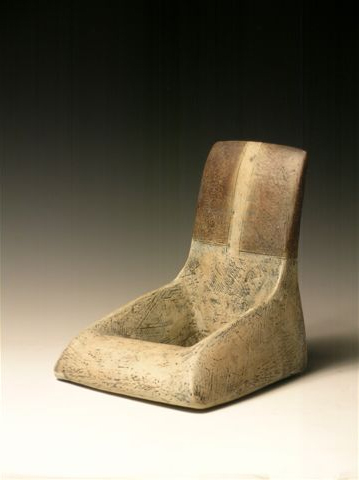
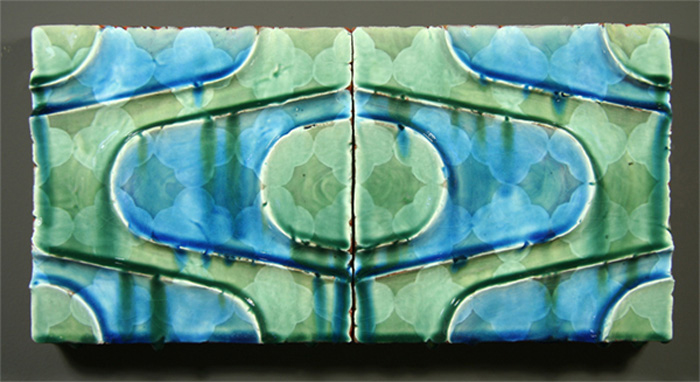
From top left, First row: Bobby Silverman, Gertraud Möhwald, and Magdelene Odundo;  Second row: Hans Coper, Viola Frey, Sam Chung and Gary DiPasquale;  Third row: Andrea Gill, Jeanne Quinn, and Mary Barringer;  Last row: Jason Green and Alan Caiger-Smith.

Visit Part I here to see not only the first grouping but also what I mean by “love” (vs. influence).  I enjoy putting these love montages together and hope to do one every so often.  I welcome you to leave a list of your all-time favorite contemporary clay artists in the comment section.

Kanthal Wire-handled Basket

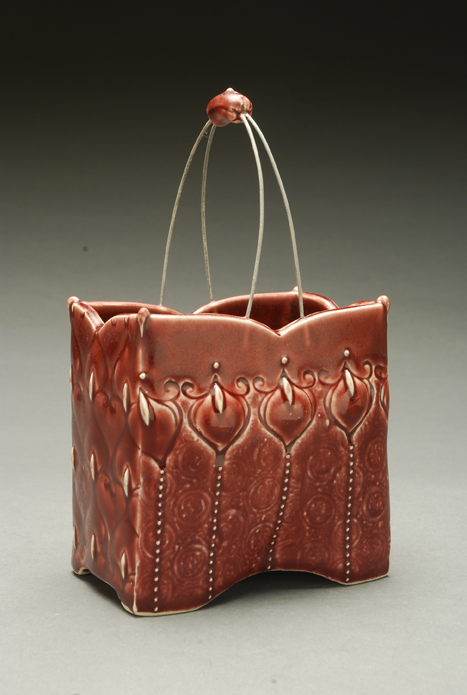
Kristen_Kieffer_Wire_BasketThis is a lil’ Wire Basket (7″h x 4″w x 3″d) I made over three years ago.  I enjoyed making it, and have continued to like it, but just this week decided to make more.  My ideas are frequently ahead of my fingers.  I have described my process —including idea- development— as being glacial at times.  (This piece seems to exemplify the point.)  My sketchbooks contain more ideas than I will probably ever make.  I’m not quite sure what makes the time seem right to pursue certain ideas, but this one’s has arrived!

I have used Kanthal wire on certain forms for years as a way to “draw” in space with another material.  (Check out the Wire Flowerbrick on my Gallery page, and a brief explanation of Kanthal wire on my Process page.)  More to come!