Wall Candy


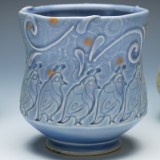
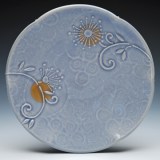
Every other year or so, I make a small series of wall forms, each more elaborate than the last. At almost 3″ deep, they’re too dimensional to be called a tile, and too soft-looking to be called a box; so “pillow” seems the most suitable term for this round, as they are plumper and poofier than ever before. I really like making these forms. I mean, I really like making these…A LOT. They are my opportunity to explore layered pattern over volume without having to balance function. (Though I make sure they hang easily, and their purpose is adding beauty, so they ‘function’ perfectly!)
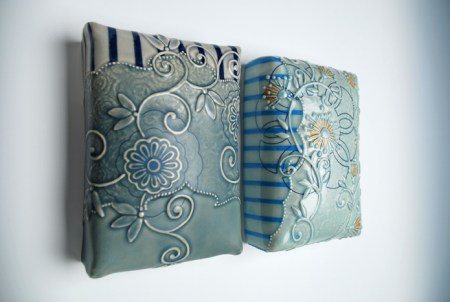
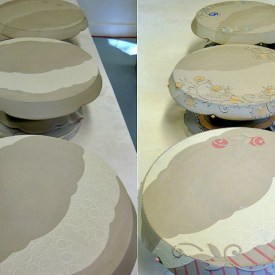
I think of these pieces as being collage because I’m assembling disparate pattern as well as layering four different ceramic decoration techniques (slip-sponge, underglaze, slip-trail, and mishima). But I also think of them as little paintings because I’m applying color and texture to a surface; the deco and the canvas are just both ceramic. So, ‘ceramic collage pillow paintings’ ~ perfect for adding a lovely focal point to your home décor, solo or grouped. Or just call them ‘wall candy,’ that suits me and my influences just fine.

This is just the beginning of what’s new for 2013 from my studio, some of which are already available in my online shop. These rich layers have also made their way onto some of my yunomis and large plates, all also debuting exclusively in my Etsy shop in the New Year. More posts on form and deco newness coming up with a few teasing glimpses on my Facebook page in the album New Work 2013.

Studio Cycles Pictorial 2012


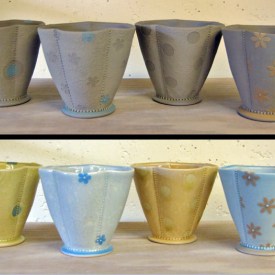
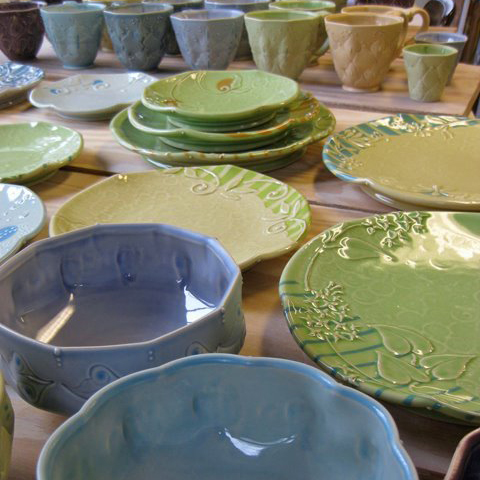
I enjoyed putting together this second annual, end of the year group of images from my studio of in progress and new work. These are just a selection of images I posted throughout the year on my Facebook page. As with last year’s, it’s not an order, it’s a cycle. I just completed two glaze firings, so more to come —immediately!— for 2013 here and in my online stores. Keepin’ on, keepin’ on!
Thank you very much for your continued support of my work and studio.
A happy, healthy New Year to you and yours!

Polka Dot Origin, Influence, & Faves

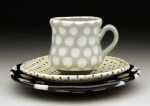
Dots on my pots!

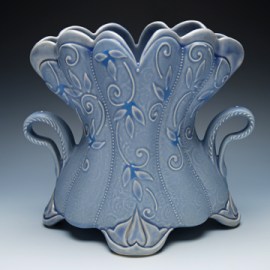
  Corset series vessel w. dots    
  

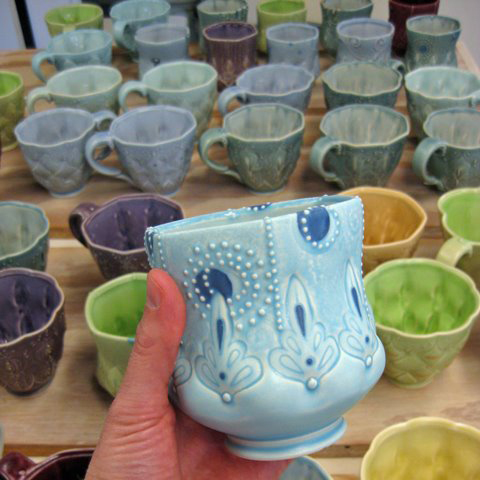
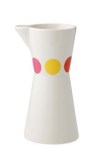
My recent work with dots: Screen vase pair, yunomis, flower vessel (Corset series), pitcher, small covered jars, small stamped bowls, and plate.

I started layering dots (and stripes, which will be a future blog post with more influences and faves) in early 2010. The added pattern came through self-critique and seeing a need to both visually pop the raised slip-trail patterns by providing small background color, as well as add some modern fun to the Victorian flavor of my work.

So the primary purpose for the polka dots was to further my love of layered surfaces for the pots, formally creating even more richness and depth. The dots punctuate the patterns.

A close secondary function for the dots has been to add some joyfulness; polka dots are rarely somber. Though I do receive some comments by folks who favorably see ‘Disney,’ I think my pots can appear more serious than I actually am or intend. In some ways, I’m still the five-year-old tomboy who hated my freckles (my own personal polka dots), deciding one summer day that, with the aid of my grape-smelling marker, they would be much better purple. So, the dots are a way to include my influences of sweets, for example, as well as infuse connotations of informality and playfulness.

You can check out all the dotty pots in my online shop.

Polka dot influences below with more here:


Norma Kamali dressTattoo round rug by Deanna Comellini  
  

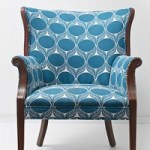
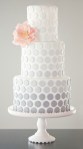
.Pictured above from top right, first row: Peter Murdoch ‘Dot chair’ for kids; Dot window building in Beirut, Lebanon; and ‘Confetti’ tree skirt.  Second row: Draga Mathilde sofa; and Yayoi Kusama concept store for Louis Vuitton.  Third row: June Leaf organic canvas in Marine; Mod fashion;  and vintage dress.  Fourth row: White-grey ombre dot cake; paper straws; and slipper chair.  Fifth row: Norma Kamali dress; Tattoo round rug by Deanna Comellini; and ‘Op-art Attracts’ wedge by ModCloth.  Last row: Quilt in progress by Judy Martin and starfish.

The origin of the Polka Dot: It is believed that the name “polka dot” came from the Polish polka dance, and first appeared by name in 1854 in The Yale literary magazine. At the same time that the polka dance and music began in the mid 19th century, polka dots were popular and common on clothing. The pattern name was chosen simply because the dance gained such acclaim, which led to many contemporary products and fashions also taking the name. (There used to be “polka-hats” and “polka-jackets,” for example.) Most disappeared with the popularity of the actual polka dance in the late 1800s. Only the printed fabric pattern remained fashionable, and the name stuck.

Polka dot favorites of fellow studio potters and ceramic artists:

Andrew Martin  Brenda Quinn  Malene Helbak
Kari Radasch  Jun Kaneko polka dot sidewalk, Art Museum of South TX
Chiho Aono  Sandblasted process, Hans Tan Studio via Ateliér Keramiky  Ayumi Horie
Harrison McIntoshMeredith Host  Harumi NakashimaTetsuo Hirakawa  Betty Woodman  Sean O'Connell

Pictured above from top right, first row: Andrew Martin, Brenda Quinn, and Malene Helbak.  Second row: Kari Radasch and Jun Kaneko.  Third row: Chiho Aono, Hans Tan Studio, and Ayumi Horie.  Fourth row: Harrison McIntosh, Meredith Host, and Harumi Nakashima.  Last row: Tetsuo Hirakawa, Betty Woodman, and Sean O’Connell.

Glaze Palette 2012


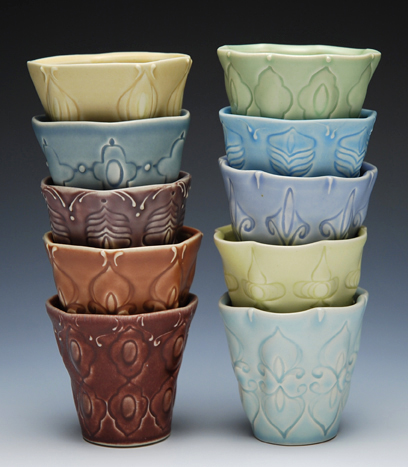
Colors clockwise from top right: Spring Green, Aqua, Periwinkle, Yellow Pear, Frost, Garnet, Rosa, Grape, Cornflower Blue, and Honeycomb. After several adds and subtractions for 2012, these are the current, and lush, satin colors from my studio. Each satin has a corresponding glossy version for the interiors, for aesthetic contrast as well as function. (Pots that are mostly interior, like plates and some bowls, are glazed completely in gloss.) Every item in my online Pottery Shop is labeled with it’s color name so you can search by color to find your favorites.

I run extensive tests to develop new colors for my palette, and then mix large amounts of each glaze by hand for dipping and pouring. There is a Glaze Testing album on my Facebook page with more pix of the steps behind the results, and a bit more about my techniques and materials on my Process page. I enjoy adding new colors, even though the process to get there is laborious. The end results are very satisfying…and ColorFULl! 

Big Honors! CM & NCECA

I’m thrilled to share that my work was chosen for Ceramics Monthly‘s September 2012 cover! CM is the most popular clay magazine in the biz with a total market reach of over 140,000. It is a huge honor that is in conjunction with a thoughtful, four-page article titled “Kristen Kieffer: The Impact of Daily Elegance” written by Kansas State University graduate student Lauren Karle. Big, huge thank yous to Lauren for contacting me, the lovely writing, and hard work through the process. Thank you, Lauren and CM!

The second big honor announcement is that I will be one of four demonstrators at NCECA‘s (National Council on Education for the Ceramic Arts) conference for 2013 in Houston, TX, March 20 – 23! What a thrill to be asked to demonstrate at the largest annual gathering of clay folk in the world, where upwards of 4,000 makers, teachers, and collectors meet to see great work, listen to provocative lectures and panels, and watch awesome demos. If you’re heading to Houston, come see me on stage Thursday morn, 9-noon and Friday afternoon, 1-4, and give me a cheer of support! Thank you, NCECA!

Pierced Pottery: Basket Faves & Influence


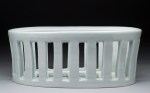
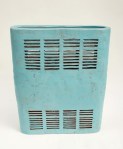
A couple weeks ago, I was in my studio pondering, and had a ‘piercing epiphany.’ I haven’t had time to do more than draw just yet, but am excited about expanding my use of piercing/reticulation/cut-outs (as pictured above) on some new and existing forms as a way to play with line, light and shadow, and form through articulated pattern.

The development of new forms paired with new surfaces is a given goal, but some days I feel more inspired (a.k.a. internally pressured) to bring that back-burnered desire to the fore. That drive usually sends me to my books on silver, my favored springboard for new forms. (It is perhaps odd to be influenced by centuries-old objects with functions so specific, many are now obsolete, but most any form for me can become an idea for a vase, which can then lead to many more ideas.)

So I was down in my studio thinking, but my books were upstairs and are worn from years of gleaning, and my computer was downstairs with me and filled with new, enticing images I’ve been bookmarking, so of course, I opened my computer. I visited my own Pinterest boards where I ‘pin’ both objects I enjoy (favorites) and objects that inspire my forms and surfaces (influence). A common thread popped out to me from my Form & Pattern, Oldies But Goodies, Ceramics: Vintage/Historical, and Ceramics: Studio Potters/Artists boards, and sent me to my sketchbook to draw: Piercing.


Pierced work was very popular in both silver and pottery in the 18th century (particularly the latter half) in England and Europe. I haven’t found specific information claiming so, but piercing seems a wonderful blend of form and function: the cut-outs allow air circulation (for food service and storage) while both visually defining form and lightening materials (silver, clay, wood) that can otherwise appear a bit more heavy or dense. (I sometimes envy glass’ ability to be simultaneously solid and transparent.) I also enjoy pierced elements in architecture, furniture, clothing, and many more mediums.

So, I’ve yet to get started on my own cut-outs, but have done some drawings, am very excited about minimal and maximal piercing (particularly for fruit bowls and baskets), and collected some of my favorite basket-y forms by fellow studio potters mixed in with ones from the 18th c. for you below. Enjoy, check out my new Pinterest board Cut-out & Cagey, and stay tuned for some pierced pots from my own studio!


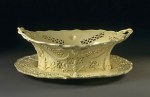
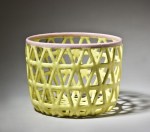
From top left: Rebecca Chappell; Shorthose & Heath creamware; and Kari Radasch. Second row: Dr. Wall chestnut basket, c. 1750s; and Bryan Hopkins. Third row: Baddelly creamware basket, c. mid 1700s; and Creamware basket, c. 18th century. Fourth row: Brian Jones; and Bruce Cochrane. Fifth row: Odette fruitbowl w. silver stand; Steven Godfrey; and Monticello creamware basket (reproduction). Sixth row: Malene Mullertz; and Julie Crosby. Seventh row: Spode Pierced Creamware Basket and Stand, c. 1820. Last row: Sunshine Cobb; and Remodelista ‘Farmer’s market basket’.