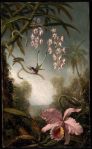
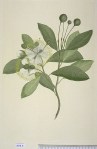
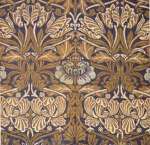
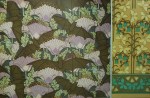
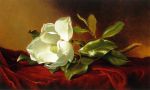
From top left: an Australian illustration; Orchids & Spray Orchids with Hummingbirds painting by Martin Johnson Heade; coloured engraving by Daniel Mackenzie; peacock and peahen illustration; rooster woodcut by J. Hnizdovsky; Second row: image plate from the book Plants & Their Application to Ornament; Passion Flowers & Hummingbirds painting by Martin Johnson Heade; Kingfishers, Dragonflies & Flowering Rush and Butterflies & Wood Sorrel illustrations by M. P. Verneuil; Third row: Tulip & Rose fabric by William Morris (1876); illustration by Mrs. Vallentin from the book Women of Flowers: A Tribute to Victorian Women Illustrators (J. Kramer, 1996); “Neoclassical floral design” wedding cake* by JollyBe Bakery; Golden Lily drawing for wallpaper by William Morris; Fourth Row: Bats & Poppies and Butterflies & Bellflowers illustrations by M. P. Verneuil; A Magnolia on Red Velvet painting by Heade.
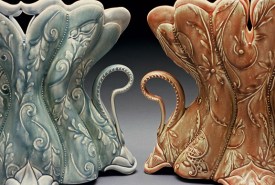 Floral, or at least curlicue, imagery has been a part of (i.e. handles) or on the surfaces of my work for a while. But it was a more general reference. In the last two years, I have begun to place some of the botanical and animal (especially birds) imagery I enjoy, more literally into the surfaces. (I purposefully wrote “into” instead of “onto” because I hope the way that I apply slip, stamp and carve the surface makes the imagery feel a bit more a part of the form rather than flat.)
When I look at the illustrations above, what I like are the soft, repetitive lines that resolve themselves into symmetrical, organic pattern iced with color. The botanicals are easy to come by at antique shops, and I own a few. These drawings appeal to me more than a photograph would; they have a different kind of detail, slightly stylized and romantic. The Nouveau drawings and prints appeal to my sense of pattern and layering—a bird disappeared into a thickness of leaves.
I’m pretty sure the first Martin Johnson Heade painting I saw was at the National Gallery in D.C. a few years ago. They are striking in person, especially for their modest size. They have a wonderfully mysterious atmosphere and depth I would like to capture in some of my own bigger pieces.
 My favorite class as a kid —other than art— was my fifth grade science class with Mr. Morton in Louisville. He could imitate the sound of every bird in the field and trees behind the school, and describe their peculiar behaviors. I thought that was really cool. Between him and my parents, my interest (that curiosity and admiration) in nature, has been there for awhile, but I’ve only just now figured out how I might include it in my work. I think too, in our current culture, we need to reconnect with what’s outside.
Briefly, the peacock and rooster images have popped up in my work lately as an amusing way to quietly question the gender of decoration. If a decorative male bird is featured on work that is perceived as feminine because it is decorative, is it [the work] feminine or masculine? (Did ya catch that?)
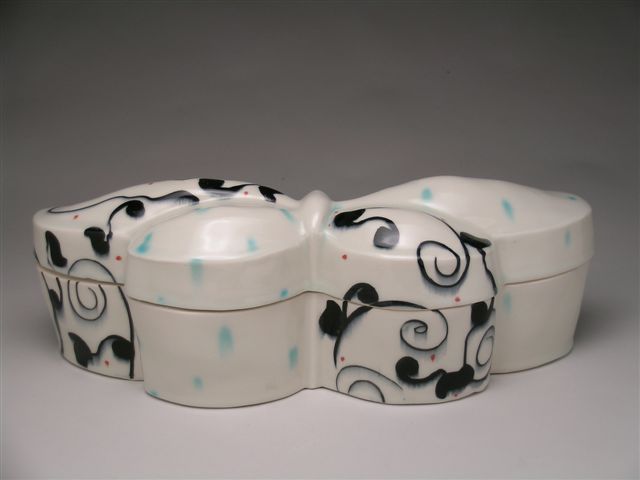
 I just completed the two greenware covered jars pictured here (not a great image, sorry). This is a new form for me, and bigger too. The one on the left (15″h) has lilacs, and the other (13″h) reminds me of wallpaper.
On a different note, I am off for two weeks to play in clay with a group of other artists during a residency at Watershed called Artists-Invite-Artists. So I’m signing off for that time. May I suggest, while I am stepping away from my computer, that we all spend some of the summer reading real words on paper, like the imminent issue of SP hitting theoretical newsstands post haste!!
*Another cake, I know, I couldn’t resist. I also forgot to mention in the post below that I listen to CAKE all the time. These cakes from JollyBe are amazing, and will probably be featured here every time I mention an influence because she has one for everything! The one I pictured above stated with the image, “…design derived from a mattress cover chosen by the bride who uses mattress design as a source of inspiration for her own art.” How perfect is that for what I’ve been writing about?!
Back in July!



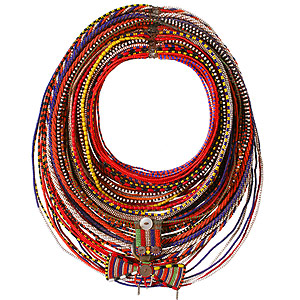


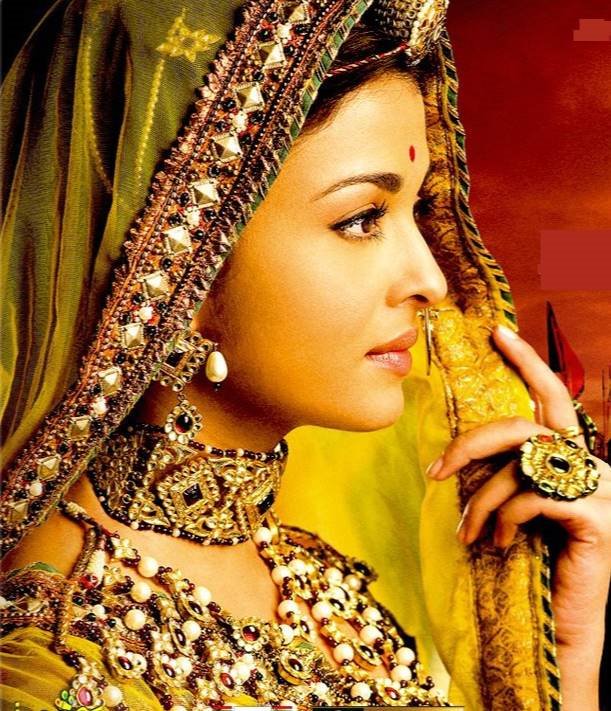


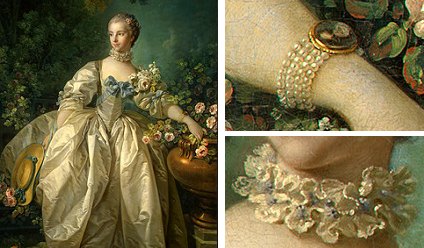
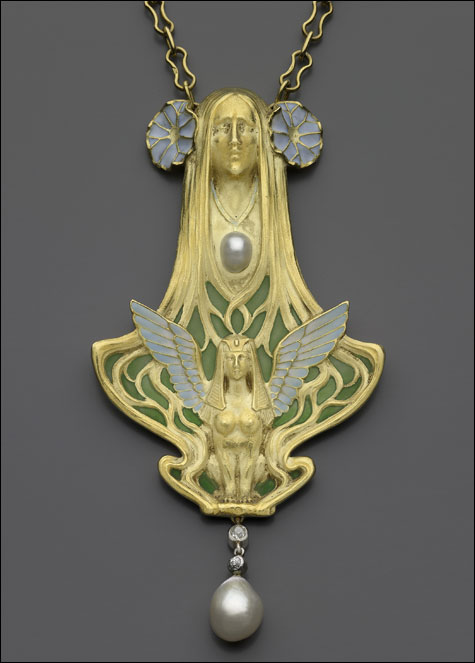

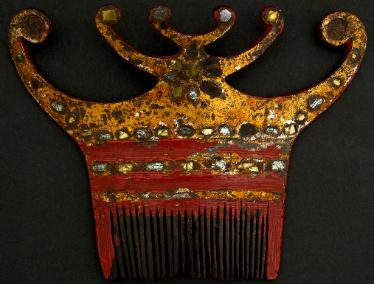
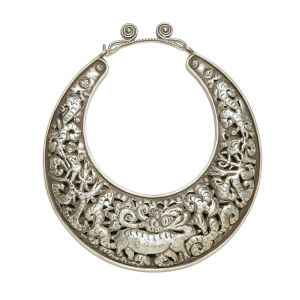
 Several of my past sketch/idea books have pictures and xeroxes from museum exhibitions and books about traditional jewelry, beads and adornment. I enjoy the patterns, shapes, forms, ornamentation, colors, intricacy, layering and elegance, as well as the symbolism and meaning of jewelry from different time periods and cultures. Elements of adornment have influenced my work in various ways over the years. My pots can look “jeweled” or like over-sized jewelry components I think. The shape of a traditional Ga’u amulet lends itself to the idea and drawing of a large covered jar, or the negative shape created by a Victorian necklace becomes the lip of a pot.


 I thought I would include some of my favorite contemporary, handmade necklaces too. From left to right: Funky Felt Necklace by Rose Tutu in Montreal; Textil Art Necklace by Maria Cavallero in Argentina; Precious Zip It Necklace by Londi Creations in France; and Wood Resin Cluster Necklace* by Modica Design in Oregon. (*Happily, I received this necklace as a gift from my husband.)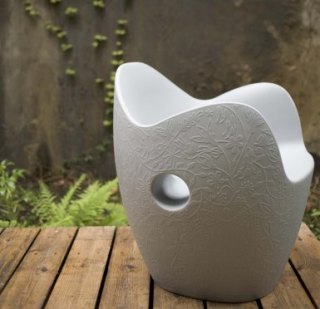





















 Kristen Kieffer