Bird & Botanical Influences

illustrationM.J.Heade OrchidsMckenzie engravingPeacockJ.Hnizdovsky woodcutWilliam Morris lily drawingPlant Ornament bookM.J.Heade passionNouveau patternWilliam Morris Tulip and RoseVallentin illustrationJollyBe cakeNouveau patternM.J.Heade magnolia
From top left: an Australian illustration; Orchids & Spray Orchids with Hummingbirds painting by Martin Johnson Heade; coloured engraving by Daniel Mackenzie; peacock and peahen illustration; rooster woodcut by J. Hnizdovsky; Golden Lily drawing for wallpaper by William Morris; Second row: image plate from the book Plants & Their Application to Ornament; Passion Flowers & Hummingbirds painting by Martin Johnson Heade; Kingfishers, Dragonflies & Flowering Rush and Butterflies & Wood Sorrel illustrations by M. P. Verneuil; Third row: Tulip & Rose fabric by William Morris (1876); illustration by Mrs. Vallentin from the book Women of Flowers: A Tribute to Victorian Women Illustrators (J. Kramer, 1996); “Neoclassical floral design” weddoing cake* by JollyBe Bakery; Bats & Poppies and Butterflies & Bellflowers illustrations by M. P. Verneuil; A Magnolia on Red Velvet painting by Heade.

Kieffer corset detailsFloral, or at least curlicue, imagery has been a part of (i.e. handles) or on the surfaces of my work for a while. But it was a more general reference. In the last two years, I have begun to place some of the botanical and animal (especially birds) imagery I enjoy, more literally into the surfaces. (I purposefully wrote “into” instead of “onto” because I hope the way that I apply slip, stamp and carve the surface makes the imagery feel a bit more a part of the form rather than flat.)

When I look at the illustrations above, what I like are the soft, repetitive lines that resolve themselves into symmetrical, organic pattern iced with color. The botanicals are easy to come by at antique shops, and I own a few. These drawings appeal to me more than a photograph would; they have a different kind of detail, slightly stylized and romantic. The Nouveau drawings and prints appeal to my sense of pattern and layering—a bird disappeared into a thickness of leaves.

I’m pretty sure the first Martin Johnson Heade painting I saw was at the National Gallery in D.C. a few years ago. They are striking in person, especially for their modest size. They have a wonderfully mysterious atmosphere and depth I would like to capture in some of my own bigger pieces.

Kieffer cups w. animalsMy favorite class as a kid —other than art— was my fifth grade science class with Mr. Morton in Louisville. He could imitate the sound of every bird in the field and trees behind the school, and describe their peculiar behaviors. I thought that was really cool. Between him and my parents, my interest (that curiosity and admiration) in nature, has been there for awhile, but I’ve only just now figured out how I might include it in my work. I think too, in our current culture, we need to reconnect with what’s outside.

Briefly, the peacock and rooster images have popped up in my work lately as an amusing way to quietly question the gender of decoration. If a decorative male bird is featured on work that is perceived as feminine because it is decorative, is it [the work] feminine or masculine? (Did ya catch that?)

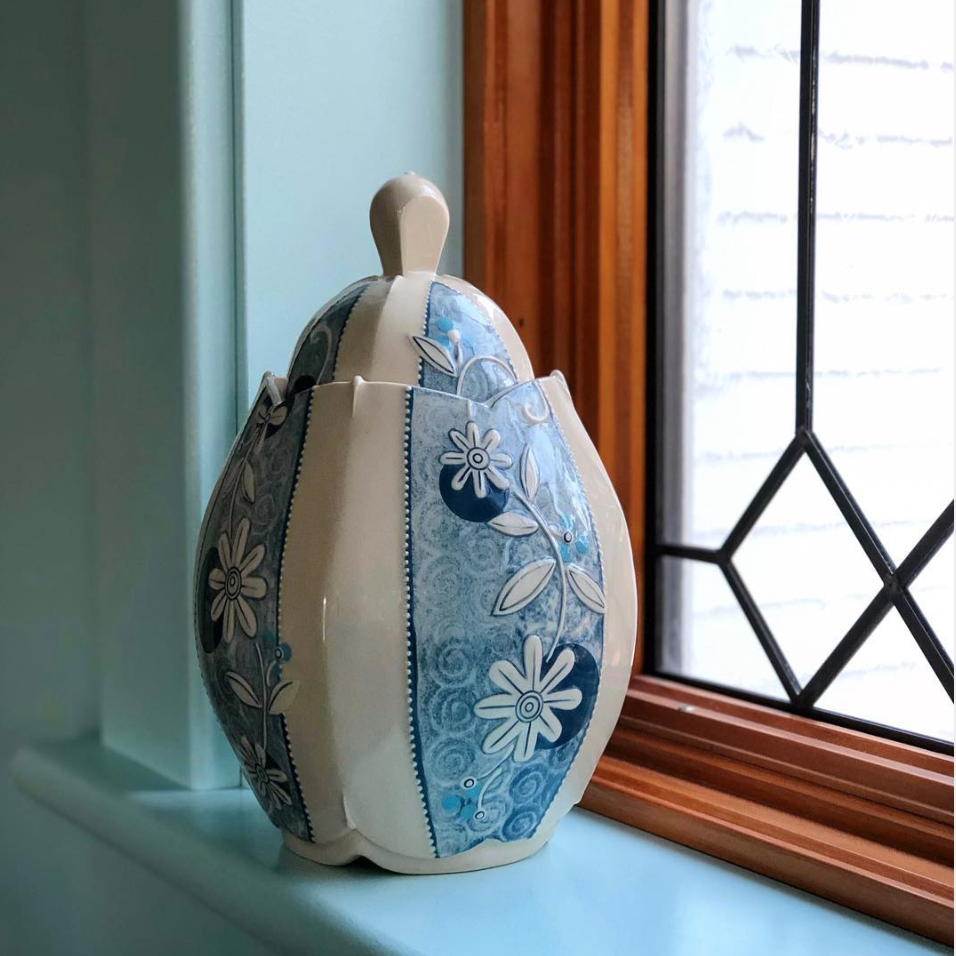
Kieffer covered jars I just completed the two greenware covered jars pictured here (not a great image, sorry). This is a new form for me, and bigger too. The one on the left (15″h) has lilacs, and the other (13″h) reminds me of wallpaper.

On a different note, I am off for two weeks to play in clay with a group of other artists during a residency at Watershed called Artists-Invite-Artists. So I’m signing off for that time. May I suggest, while I am stepping away from my computer, that we all spend some of the summer reading real words on paper, like the imminent issue of SP hitting theoretical newsstands post haste!!

*Another cake, I know, I couldn’t resist. I also forgot to mention in the post below that I listen to CAKE all the time. These cakes from JollyBe are amazing, and will probably be featured here every time I mention an influence because she has one for everything! The one I pictured above stated with the image, “…design derived from a mattress cover chosen by the bride who uses mattress design as a source of inspiration for her own art.” How perfect is that for what I’ve been writing about?!

Back in July!

Cake as Influence

Thiebaud cakeA. Steeter cakeOldenburg floor cakeCake Girls Couture cakeThiebaud wedding cakeM. Braun cakeTrend de la Creme blog imageCupcake colorArchitecture as cakeJulia Jacquette cake painting
From top left: Wayne Thiebaud’s painting Let Them Eat Cake; Painted Bird Cake, (a real cake) by Amanda Streeter; Floor Cake by Claus Oldenburg; and couture wedding cakes. Second row: another couture wedding cake; Wedding Cake by Wayne Thiebaud; a real wedding cake by Margaret Braun; a great blog entry from Trend de la Cremé pairing runway fashion with couture cakes; Third row: cupcakes by Dozen Cupcakes; architecture as cake; and Julia Jacquette’s painting White on White (Thirty-six sections of wedding cake, swans).

I started looking at wedding cakes eight years ago for decoration ideas. It seemed an obvious reference for me as slip-trailing (squeezing liquid clay through a bulb syringe) is the clay equivalent to cake-decorating.

I’m not sure when I first came across Wayne Thiebaud’s pastry paintings from the ’60s, but I love them. If I could paint, that is the style and possibly content I would choose. I enjoy his fantastical and exaggerated use of color (hard shadows of electric pink) and style that reminds me of the vintage ads I like. The paint is thick, and somehow simultaneously gestural and precise. Some of my influences are abstract ideas, and that last sentence would be a good example of something I see [in a Thiebaud painting, for example] that I would like to emulate in my work —a feeling, a presence.

Kieffer tile trioI also just like the word, cake (the title of and text on the left tile, actually). I am drawn to the sound of certain words (Who doesn’t like to say rutabaga?), especially if they can have different meanings and contexts. I don’t know where I picked this up, but I sometimes use it as an expression to mean, “exceedingly lucky”. As in, “He is in a pretty cake situation since he married a millionaire,” for example. (There are of course the phrases “cakewalk” and “take the cake” which, in my estimation, have racially questionable origins.)

I chose Claus Oldenburg’s Floor Cake to show because it fits today’s theme, and because I am drawn to his sculpture and drawing for making real, hard forms soft and humorous. Both elements I look to capture in my own work. Kieffer Soft Treasure box

It may or may not be obvious from the images I chose above (and from my last post below): many of my influences overlap. In these things, I see hard and soft lines, humor, form, context and content. A couture dress looks like a tiered cake which looks like a Victorian home, which could be a covered jar—or maybe that’s just me. As I’ve said before, we artists are the blenders of the disparate creating the unified.

Influences: A Pictorial

Oribe wareGeorge Nelson bubble lampsMartin Johnson Heade
Bombe highboyVintage playing cardsMucha JobTord BoontjeVictorian house
W.Thiebaud CakesFruit crate ad
Haute coutureKleinReid birdcagesVintage wallpaperLouis MajorelleBotanical drawing
From top left: Oribe/Mino ware, George Nelson bubble lamps, Martin Johnson Heade paintings; (2nd row) bombé chests, imagery from vintage playing cards, Alphonse Mucha illustrations, Tord Boontje design, architecture and Victorian homes; (3rd row) Wayne Thiebaud pastry paintings, early 1900s fruit crate labels, Islamic brass forms and patterns; (4th row) haute couture, KleinReid design, vintage wallpaper patterns and textures, art nouveau design, lines and patterns –like Louis Marjorelle, and botanical drawings.

Sketchbook & Pitchers

Kieffer sketchbook pitchersKieffer greenware pitchers l
Kieffer sketchbook pitchersKieffer greenware pitchers right
I thought these images would eloquently demonstrate the importance of my sketchbook in making. I drew these images –in my handmade sketchbook– on Tuesday evening, and just finished making the four likenesses this Saturday morn. My studio time is more productive when I work from drawings and have an idea, rather than walking in and thinking, “Today I will make a new pitcher form.” The drawings are guidelines; a faster way to work through some form ideas than on the wheel. I admire artists who make spontaneously. I am not one them. And have become more successful in the work and in my head by recognizing –sounds a bit cliché– how my personality suits the making (and vice versa).

I knew two of the pitchers would be stamped and the others softly squared, but don’t usually feel the need to produce the decoration in the drawings. That is improvised later. The drawings aren’t meant to be replicated anyway. Seeing something in three-dimensions is different than two, and my drawing skills only take me so far.

I have never really made pitchers. Odd for a potter. I make one every once in awhile to play with how I might do it, but it hasn’t held my interest in the past. I demo them frequently for my students, and I think that’s what got me sketching this week. So these are some new ideas worked up from other forms of mine. One (top left) is based on my covered jars; a slightly new form (gourd-shaped) idea. The middle two reference my current teapot form. And the fourth (lower right) is a stretched version of my creamer.

I would like to see all of them bigger. I have one I like more than the others…

I mentioned my sketchbook being handmade (by me) because the type of binding –coptic, I think it’s called– allows it be opened flat for drawing and viewing. And ultimately, it feels more meaningful to draw in a book I made. This sketchbook is nearing the end pages, so I’m making another one. But the “old” one will continue to be flipped through for awhile before it gets shelved, and new ideas evolve completely into the new book.

Fresh Pots for Purchase!

Kristen Kieffer tumblersKristen Kieffer plantersKristen Kieffer stamped cup
I have finally posted some new work for sale at my Kieffer Ceramics store.
Click here to start shopping! (www.kiefferceramics.etsy.com)
Kristen Kieffer tumbler, rabbitsKristen Kieffer small bowls, animalsKristen Kieffer hourglass formsKristen Kieffer tumbler, birdsMedium covered jar, grape

Eye Candy: New Images

Kristen Kieffer stamped cups color III
Stamped cup grouping, represents my nine lusciously satin glaze colors

For most of the last two days, I have been shooting images of new work and inserting them throughout this site. The images will also be used for various publicity purposes in the future. Making and taking the time to keep up-to-date with work documentation feels like a side-track to making the work sometimes, but is very much a necessary part of the job (artist/publicist!). Once I do make the time, I actually enjoy “framing” my ceramics. (I’m significantly less fond of the understanding required for color correction and digital light metering, however.) Have a look through the other site pages for what’s new. There are additions and subtractions on most of the pages.
Kristen Kieffer covered jar group
Covered jar grouping, small and mediums

Studio Sale postscript: Thanks to all who came out, brought friends and family, and supported a local artist! It was a very enjoyable and successful weekend. I very much appreciate your purchases and support. It you weren’t able to attend, I hope to see you in October (25th and 26th) for my pre-holidays sale.

Studio Sale Countdown

Ready to glazeThese images (shot Saturday) are a glimpse of my last steps in finishing some work, and specifically for my Studio Sale this weekend.

The first image shows how I set out bisqueware (pieces fired once already to a lower temperature) when I am ready to glaze. Each piece is sorted by the color it will be glazed. (I actually just unloaded this group from the glaze kiln this morning.)

Ready to bisqueThe second image shows work that is drying and waiting to be loaded into a bisque firing. (So I was glazing and bisquing simultaneously.) The bowls are a different color because they weren’t dry like the others. Some pieces are upside-down to aid in their drying faster and evenly. (This work was glazed yesterday and loaded into the kiln this evening, except for –very unfortunately– the screen vases. I just couldn’t fit everything!)
Backyard drying
I decided the bowls weren’t drying fast enough, and Saturday was so beautiful, I walked them out from my studio to our backyard to dry in the sun.

Kieffer L & L kilns
Have I mentioned how much I love my L & L kilns and firing cone six (seven, really) electric?!

I have only had three Studio Sales prior, and while they have not been overrun with customers, they have been successful and very enjoyable. A completely different experience –for all– from a retail show. I enjoy having folks over to visit our home, and to see where I work everyday. I’m looking forward to this weekend, and hope to see you. Please contact me if you need times and directions.

In Progress—Stamped cups

Just thrown cups Kiefferjust stamped cups Kiefferpulled handles Kiefferfinished cups KiefferGreenware bunny cup KiefferI have two more making days before I begin glazing for my Studio Sale the weekend of May 17 & 18th. Today I finished a bunch of stamped cups, the form I make the most. I have made over 80 in the last six months, and only have two in my studio, both of which will actually be shipped out next week. That doesn’t mean I have sold them all, but does mean many have and the rest are in galleries waiting to be.

These images (which I have posted on another blog before, but thought I’d do so again in this new space) illustrate some of the progression and stages of my cup making process: (1) twenty just thrown, (2) the same cups after stamping waiting to be trimmed, (3) the handle parts just pulled waiting to be applied, and (4 & 5) some finished cups prior to firing.

Making. It looks like more of a production process than it really is. It takes me a solid two days (often three) to throw, stamp, alter, trim, place handles and slip-trail twenty cups. I believe this is a little slower than some. It only takes a few minutes to throw a cup or pull a handle, but I spend quite a bit of time when all is said and done (including glazing) on each cup. Part of the reason is that my handles have two parts, thus some extra work. The rest of the additional time is in the detail…like slip-trailing the bunny tails on the cup above. Though they are stamped, there is still refining of the image at various stages to be done. I fell asleep one night figuring that I touch a single cup over forty times during all the processes of making and glazing. That doesn’t include the post-steps of wrapping to ship out or take to a show.

Stamping. I have over twenty different stamps at any given time. (I try to make new ones when I get a chance, and subtract others over time.) So when I have twenty cups to decorate, I may only use the same stamp once. On the twenty I will finish tomorrow, half will be stamped with a pattern and the other half will be stamped with an animal (bunny, bird, etc.). And since I use nine different glazes, each one will be unique between the color and decoration. I’m not claiming that over the course of a year or so, there aren’t repeats of a stamp and color combo, but I do want to emphasize the one-of-a-kind nature of my work, even within a series. Everything is always changing, so it keeps things interesting for me (and you).

Outside of my “spec” work for shows, I do take commissions for more specific combinations. Last year I had one client desire four cups with four different stamps in the same color. And another want four different colored bunny cups.

Handles. I began making them in two parts during graduate school (at Ohio University) because I thought my work needed an aesthetically different kind of handle, and I was —and continue to be— influenced by metal-working. Early this last summer, I lopped off the curlicue that had long been at the end of the smaller handle section. I needed a change. And that is how things change in my work…a little at a time.

Kieffer signature
All of my work is signed, “Kieffer”. The cups have an additional chop (signature stamp) at the bottom of the handle of a mirrored “K” for my initials. I have signed all my work since I began with either or both of these.

In Progress—Screen vases

Kristen Kieffer screen vases in progressI finished this grouping of Screen vases last week. This is a series I began last summer. The individual form (a flat edge bisecting an ellipse) came out of a workshop I taught about using paper templates as a basis for sketching in three-dimensions. I was working alongside the participants folding paper, and kept some of the ideas around my studio.

While comparatively spare, I enjoy both these and the Hourglass forms (also begun last summer) because they appeal to my encompassing interest in line defining form. (Finished —glazed— versions of these are on my Sculptural Vessels page.)

The name came from how one related to the next once there were multiples. As the flat sides lined up or “accordioned”, they seemed reminiscent of folding, Chinese screens.

They look particularly striking with white tulips arching out from their tops. I will have to post a picture of that once this grouping is glazed!
Kristen Kieffer screen vases (h) in progressChinese screen

In Progress—New Tile forms

Kieffer greenware tilesKieffer greenware tiles detailThough only two shown are complete, today I finished five new sized and shaped tile forms: three are larger rectangles, and two are a new arched form. (They currently measure 11″h x 7 1/2″w x 2″d in this leatherhard stage, but have some shrinking to do.) I continue to be very excited about these wall/mantel pieces. They are one of the most enjoyable forms I make.

The tiles are more than just canvases for pattern. The forms themselves are intriguing to me; soft with edges, like a torte. I enjoy how they poof out from the wall, or belly out on a tabletop. I particularly like them in groupings. Most are made in a series intended to work together, though they rarely stay together. The ones I finished today are intended to alternate between the two shapes. The palette has already been determined (even before the surfaces were complete), so that all five will be a different color.

I treat the surfaces more like collage than clay decoration. Each one has four to five layers that overlap and intermingle, including content. Three of the new tiles have animals (rabbits and bunnies, chubby birds, and owls), and text (”THICKLY SETTLED”*, “SQUEEZE RIGHT”* and “CRYSTALLIZE”). There is really too much going on with these for one post, so I will have to discuss my interest in words and text, and animals in another at some point.

By the way, three of the rectangle tile forms on the Wall/Mantel Pieces page are available and in need of a loving home: (Untitled) (ivory), SHY/Owl (lime) and CAKE (frost). Clerestory on the New Work page is also available. Drop me an email if you have questions and would like to purchase one. The vault form, HEAVY-DUTY and small square tiles are currently on exhibition and for sale at the “Made In Clay” show at Greenwich House Pottery in NYC through 4/30.

*These amusing phrases are from street signs that seem to be particular to Massachusetts (or New England) where I have lived since 2001. When I first saw a sign reading, “THICKLY SETTLED”, I thought it meant something about the pavement. It refers to areas that are densely populated, so you need to watch your speed. “SQUEEZE RIGHT” (or left) means “merge”. (I’ve used them here in my work to signify other meanings, however.)

Next Page »